Share This Article
The first time I wore a disco outfits to a themed party, I showed up in a plain black turtleneck with some silver jewelry and called it “minimalist disco.” My friend walked in wearing a full sequined jumpsuit, platform boots, and a feather boa. I wanted to disappear into the floor.
That night taught me something: disco fashion doesn’t reward half-measures. It’s a whole commitment. And if you’re here trying to figure out what to actually wear (whether it’s for a 70s party, Halloween, a dance night, or just because you want to feel like you own the room), I’ve spent way too much time researching and testing this stuff. Let me save you from my turtleneck mistake.
What Actually Defines a Disco Outfits
Most people think disco is just “put on something shiny.” That’s like saying Italian food is just “put on some cheese.” Technically true, but you’re missing everything that matters.
Disco fashion came out of 1970s New York club culture: Studio 54, The Loft, Paradise Garage. It was about freedom, self-expression, and visibility. The clothes were designed to catch light on a dark dance floor. That’s the function behind the form.
The Core Elements You Need
There are a few things that actually make an outfit read as disco rather than just “sparkly”:
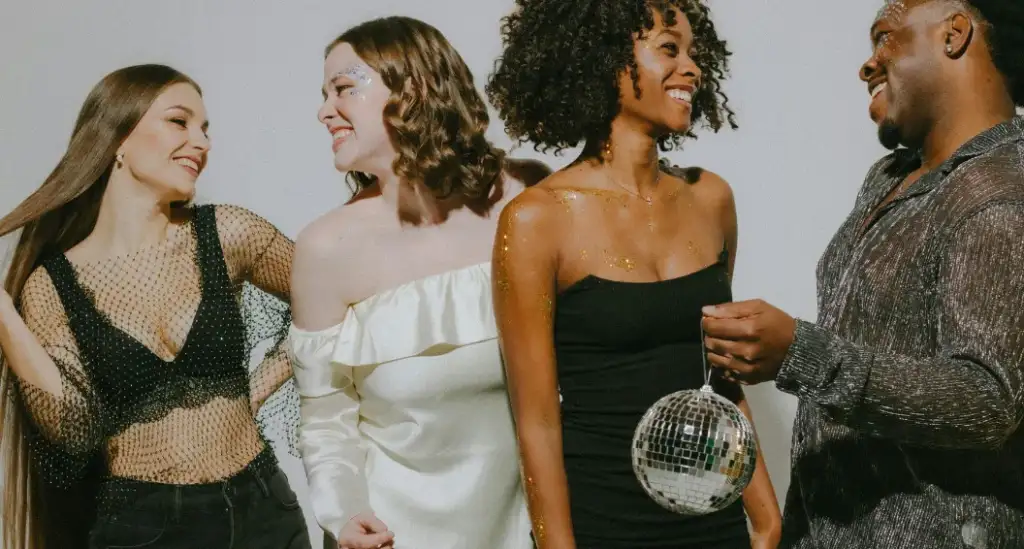
- Reflective or metallic fabric: sequins, lurex, lamé, mirror fabric
- Silhouettes with movement: flared pants, wrap dresses, flowing sleeves
- Body-conscious cuts: halter tops, deep V-necks, backless designs
- Height: platform shoes are almost non-negotiable for authenticity
- Color: gold, silver, electric blue, hot pink, burnt orange
If your outfit hits three or more of these, you’re doing disco right.
What to Skip
Rhinestone-covered jeans from a fast-fashion site? Usually looks more “country concert” than disco. Anything stiff or structured doesn’t move right under the lights. And black, while classic, works best when it’s paired with metallic elements, not worn solo.
The Best Disco Outfits for Women
I’ve tried on a lot of these. Some I’ve bought for events, some I’ve borrowed, some I’ve regretted. Here’s what actually works.
Sequined Jumpsuits
This is the power move. A well-fitted sequined jumpsuit is the closest thing to a disco cheat code. You throw it on, add platforms, and you’re done. No coordination required.
I picked up a gold wide-leg sequin jumpsuit from ASOS a couple of years back; it was around $85. Wore it to a New Year’s party and genuinely got stopped three times for compliments. The wide leg is key: it moves when you walk and photographs beautifully.
What to look for: Wide or flared leg, not tapered. Fitted through the bodice. Halter or spaghetti straps over long sleeves restrict movement and trap heat on a dance floor.
Wrap Dresses and Flowy Midi Skirts
If you want something more feminine and versatile, a metallic wrap dress or a high-waisted flared skirt with a simple top does the job. Diane von Furstenberg actually popularized the wrap dress in the 70s, specifically for the disco era, so you’re going straight to the source of the aesthetic here.
A gold or silver wrap dress can transition from a themed party to a holiday dinner without much effort. That versatility is worth paying a bit more for.
The Two-Piece Route
A sequined crop top with wide-leg trousers is probably the most comfortable option if you’re going to be dancing all night. More room to breathe, easier to manage, and you can swap out pieces for different looks.
I’ve seen the Zara metallic coord sets do this really well; usually $60-80 for both pieces, and the quality holds up better than you’d expect.
Disco Outfits for Men
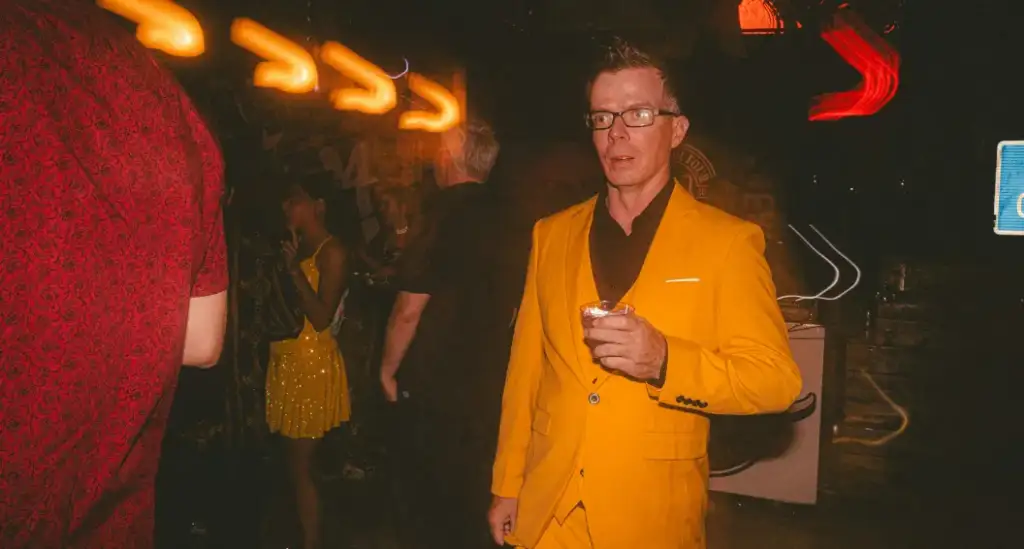
Most disco outfits guides spend two paragraphs on men and call it done. That’s frustrating because men’s disco fashion is genuinely interesting and wildly underutilized for costumes and themed events.
The Classic Men’s Disco Look
Think John Travolta in Saturday Night Fever: white three-piece suit, open collar shirt, fitted silhouette. That look works because it’s sharp but still sensual. The open-collar shirt (no tie, unbuttoned two or three buttons) was specifically a 70s disco move, pulling away from the buttoned-up corporate look of the decade before.
Key pieces:
- High-waisted flared trousers (these are making a real comeback and are easier to find now)
- Fitted shirts in satin or silk, jewel tones work great
- A blazer with lapels wider than you’re used to
- Platform boots or chunky-heeled dress shoes
Going Full Glam
Men wore sequins, metallic shirts, and even full lamé suits at Studio 54. If you’re going to a themed event and want to commit, a metallic or sequined blazer over a black turtleneck (with flared pants) is a strong look that feels grounded but very clearly disco.
ASOS and H&M both carry sequin blazers in the $50-90 range that are perfectly serviceable for events.
How to Style Disco Outfits on a Budget
Real talk: you don’t need to spend hundreds to look good. The thrift store is your best friend for disco fashion, specifically because the 70s revival has been going in and out of mainstream style for decades, meaning there’s always vintage-adjacent stuff on the racks.
Thrift Store Strategy
Go for the fabric, not the shape. If you find a great lamé top that’s a weird cut, you can have it altered. Alterations on something simple (taking in a seam, shortening a hemline) usually run $15-30 and are completely worth it.
I found a burnt orange satin blouse at Goodwill for $4. Combined with high-waisted flared jeans I already owned and gold platform sandals, it was one of the best disco outfits I’ve put together. Total cost under $30.
Amazon and Fast Fashion Reality Check
Amazon has a flood of “disco costume” options in the $25-50 range. Some are fine for a one-night Halloween situation. But the fabric quality is usually thin, the sequins shed everywhere, and the sizing runs inconsistently. If you’re planning to wear this more than once, it’s worth spending $70-100 on something from ASOS, Revolve, or even a mid-tier boutique.
Accessories That Make or Break the Look
The outfit is maybe 60% of disco fashion. The other 40% is accessories, and this is where most people underinvest.
Shoes
Platforms are the single most impactful accessory. Even a modest 2-3 inch platform changes your silhouette and posture completely. Steve Madden makes solid platforms in the $80-100 range. For something cheaper, Target’s A New Day line occasionally does platform sandals that work great.
Avoid: regular heels (too modern), sneakers (kills the vibe), or anything with a pointy toe (that’s not 70s, that’s 2000s).
Jewelry and Hair
Go big. Hoop earrings, layered chains, wide bangles. The 70s aesthetic loved volume in jewelry, not necessarily expensive, just substantial.
For hair, the era was all about natural volume: Afros, feathered wings, shaggy layers. A good volumizing mousse and some diffusing does the job. If your hair is straight, a blowout with a round brush gives you that 70s wing effect.
The Finishing Touch: A Bag
A small metallic clutch or a structured box bag in gold or silver keeps the look cohesive without overwhelming it. This is not a crossbody situation unless the crossbody is very structured and metallic.
Common Disco Outfits Mistakes (And How to Fix Them)
I’ve made most of these. Learn from me.
- Mixing too many textures at once: sequins + feathers + metallics + velvet is too much. Pick two max.
- Ignoring fit: a sequined dress that’s too loose just looks like a costume. It needs to fit.
- Wearing modern shoe silhouettes: stilettos and pointed-toe heels pull the eye to “cocktail party,” not “dance floor.”
- Forgetting the era’s color palette: neon reads as 80s, not 70s. Stick to warm golds, earthy oranges, electric blue, and jewel tones.
- Over-accessorizing the hair: one statement hair accessory (a rhinestone clip, a silk scarf) is better than three.
Putting It All Together for Different Occasions
A disco outfits for Halloween is different from one for a themed dinner party, which is different from one for a retro dance night where you’ll actually be on a floor for four hours.
For dancing: Comfort matters. Two-piece coords, breathable fabric, secure shoes with ankle straps, so you’re not losing them mid-spin.
For a party or event: You can go more dramatic, the full jumpsuit, the feather boa, the statement jewelry.
For a photoshoot or costume contest: Go maximalist. This is where the full sequined gown or head-to-toe lamé suit earns its keep.
Conclusion
Disco outfits are one of the most fun fashion spaces to play in because the era genuinely celebrated people who took up space, looked joyful, and dressed like they wanted to be seen. That energy is contagious.
Start with one strong piece (a jumpsuit, a sequined top, a pair of platforms) and build from there. You don’t need to buy everything at once. The best disco outfits I’ve seen aren’t the most expensive; they’re the most committed.
Wear it like you mean it, whatever you get together. That’s the actual secret.
Ready to light up the dance floor? Tell me your favorite disco piece (sequins, platforms, or flares) in the comments, and I’ll suggest a killer outfit around it.
Frequently Asked Questions
1. What should I wear to a disco-themed party?
Go for something shiny and movement-friendly, such as a sequined jumpsuit, metallic dress, or flared pants with a satin shirt. Add platform shoes and bold accessories to complete the look.
2. Can I wear black to a disco party?
Yes, but pair it with metallic or reflective elements. A plain black outfit alone can look too modern or minimal, so add sequins, lamé, or statement jewelry to make it disco-ready.
3. Are platform shoes necessary for a disco outfits?
They’re not mandatory, but they make a huge difference. Platforms instantly give that authentic 70s silhouette and help your outfit feel true to the era.
4. How can I create a disco outfits on a budget?
Check thrift stores for metallic fabrics, satin shirts, and flared pants. You can also build a look around one standout piece (like a sequined top) and keep the rest simple.
5. What hairstyles work best with disco fashion?
Big, voluminous styles fit the vibe; think feathered layers, soft waves, blowouts, or natural curls. The goal is movement and fullness rather than sleek styles.